Industrial water pollution treatment is the largest application of activated carbon filters market

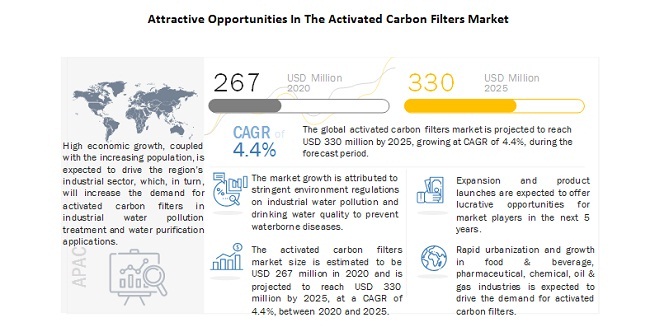
The global activated carbon filters market size is estimated at USD 267 Million in 2020 and is projected to reach USD 330 Million by 2025, at a CAGR of 4.4%, between 2020 and 2025. Activated carbon filters are used to remove organic compounds, and free chlorine from water to make it suitable for drinking and reuse in manufacturing processes or to discharge in water bodies. They are used to remove organic elements, such as humic acid and fulvic acid from potable water to prevent the formation of trihalomethanes, a class of carcinogens. They are also used for air/gas filtration in various industries. The filter media, which is used in the filtration process is activated carbon, also known as activated charcoal. Activated carbon is a form of carbon that removes organic compounds from liquids and gases by a process known as “adsorption”. It is extremely porous and thus has a very large surface area available for adsorption.

Download PDF Brochure: https://www.marketsandmarkets.com/pdfdownloadNew.asp?id=213859954

The industrial water pollution treatment application is expected to be the largest, and drinking water purification application is expected to be the fastest-growing segment in the overall market. The global activated carbon filters market is mainly driven by the implementation of stringent regulations by regional governments and environmental agencies to control water pollution. Also, activated carbon filters are used to treat industrial discharge to re-use it in the manufacturing rocess again. Re-use of industrial discharge water and water pollution control are the two major making industrial water pollution treatment the largest application in the market.

APAC is the largest as well as the fastest-growing market for activated carbon filters market.

APAC is estimated to be the largest market for activated carbon filters in 2019. The market for this region is segmented into China, India, Japan, Malaysia, Indonesia, and the Rest of APAC. According to the World Bank, APAC is the fastest-growing region in terms of both population and economy. The region has witnessed significant growth in the past decade, accounting for over one-third of the world’s GDP. High economic growth, coupled with the increasing population, is expected to drive the region’s industrial sector. This is expected to increase the demand for activated carbon filters in water pollution treatment and water purification applications.

Recent Developments 

  1. In January 2020, Kuraray expanded its Mississippi (US) activated carbon plant, which will increase the capacity of the plant by 50 million pounds of granular activated carbon (GAC) annually. GAC is used as filter media in activated carbon filters. This expansion will help the company to cater to the growing needs of activated carbon filters in the North American region.
  2. In April 2020, Cabot Corporation acquired Shenzhen Sanshun Nano New Materials Co., Ltd (SUSN) (China). This acquisition will help the company to strengthen its market position in the APAC region.

The key companies profiled in this report on the activated caron filters market include TIGG LLC (US), Puragen Activated Carbons (US), Cabot Corporation (US), Westech Engineering (US), Kuraray Co. Ltd. (Japan), Lenntech B.V. (The Netherlands), Donau Carbon Corporation (Germany), General Carbon Corporation (US), Sereco S.R.L. (Italy), Carbtrol Corp (US).

Request for Sample Report: https://www.marketsandmarkets.com/requestsampleNew.asp?id=213859954
Asia Pacific is projected to be the largest consumer of water storage systems

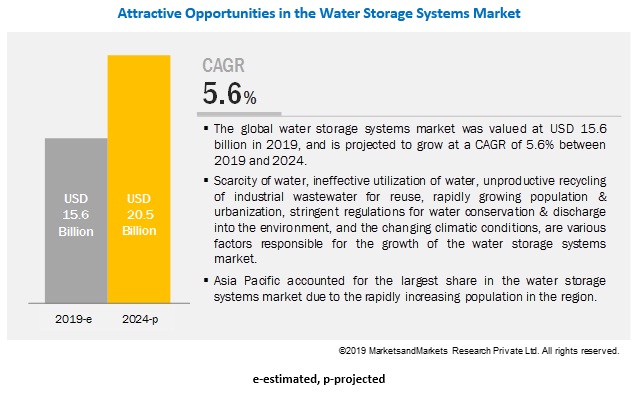
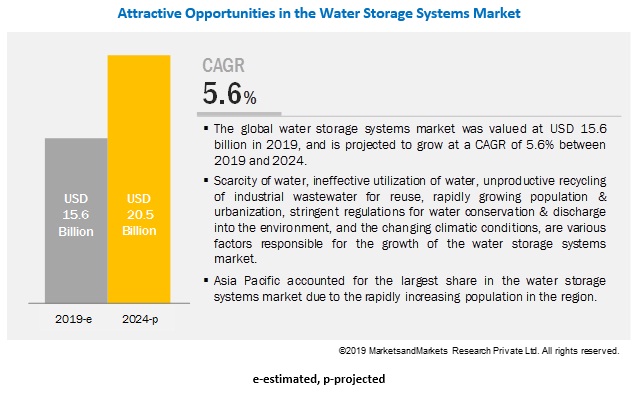
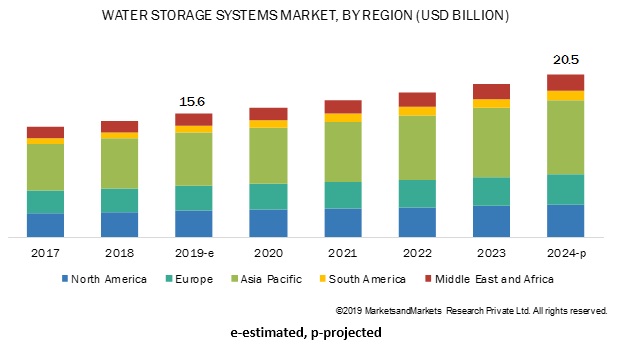
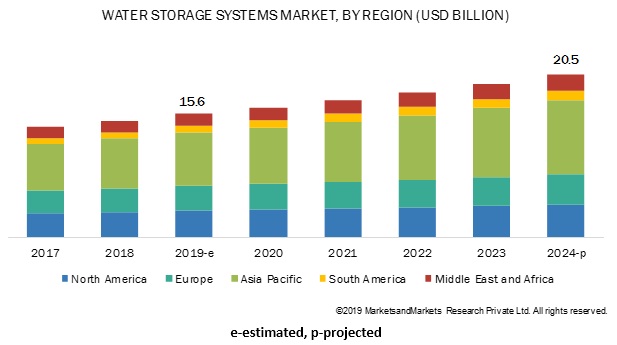
The global water storage systems market size is estimated to be USD 15.6 billion in 2019 and projected to reach USD 20.5 billion by 2024, growing at a CAGR of 5.6% from 2019 to 2024. Rapidly increasing population & urbanization, recycling of industrial wastewater, water scarcity, ineffective water management, stringent regulation for conservation & consumption of water, and falling levels of rainfalls are the significant drivers for the growth of the water storage systems industry.

Download PDF Brochure: https://www.marketsandmarkets.com/pdfdownloadNew.asp?id=112310652

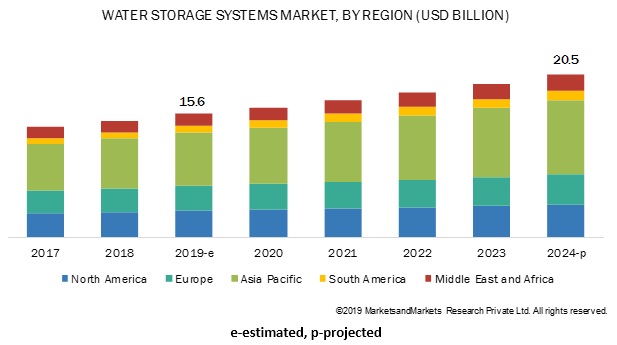
By region, the industry is segregated into Asia Pacific, the Middle East & Africa, North America, Europe, and South America. Among these, Asia Pacific is expected to lead the water storage systems market during the forecast period. This growth is attributed to the scarcity of water, ineffective utilization of water, inefficient recycling of industrial wastewater for reuse, rapidly growing population & urbanization, stringent regulation for water conservation & discharges into the environment, and falling levels of rain, among others.

Companies such as CST Industries, Inc. (US) and McDermott International Inc. (US), Containment Solutions Inc., (US), DN Tanks (US), Caldwell Tanks (US), Balmoral Tanks Limited (UK), and Synalloy Corporation (US) are the major players in the water storage systems market. These players have been focusing on strategies such as acquisitions, new product developments & launches, agreements, and investments that have helped them to expand their businesses in untapped and potential markets. The diversified product portfolio and multiple uses are factors responsible for strengthening the position of these companies in the global market.

Concrete material is expected to lead the water storage systems market

Based on material, the market is segmented into steel, fiberglass, concrete, plastic, and others. The others include collapsible tanks, wood tanks, and open-lined pits. The demand for these water storage systems depends mainly on the properties of the raw materials such as corrosion resistance, durability, weight, strength, and cost, among others. The concrete segment holds the largest share of the global water storage systems market and will continue to be the largest segment during the forecast period as well.

Hydraulic fracture storage & collection application is expected to lead the water storage systems industry

Based on application, the water storage systems industry is divided into hydraulic fracture storage & collection, on-site water & wastewater collection, potable water storage systems, fire suppression reserve & storage, rainwater harvesting & collection, and others. The other applications of water storage tanks include irrigation, secondary containment systems, and marine applications. Increasing oil & gas exploration activities around the globe with major ongoing projects such as Zubair Oil Field-Rehabilitation Phase (RP) and Enhanced Re-Development Phase in Iraq, East Natuna Block (Natuna D-Alpha) project in Indonesia and others are expected to drive the growth of hydraulic fracture storage & collection water storage systems market.

Request for Sample Report: https://www.marketsandmarkets.com/requestsampleNew.asp?id=112310652

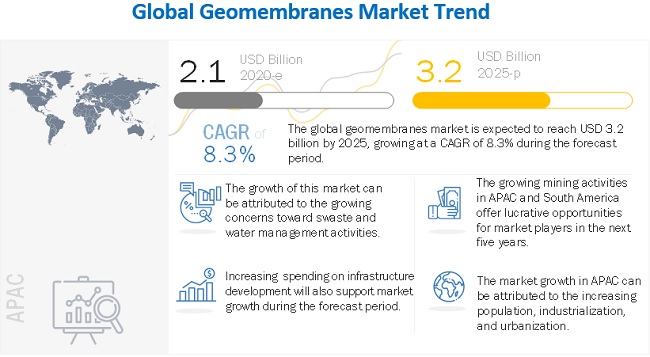
Increasing spending on infrastructure development driving the market of Geomembranes Market

The global geomembranes market size is expected to grow from USD 2.1 billion in 2020 to USD 3.2 billion by 2025, at a Compound Annual Growth Rate (CAGR) of 8.3% during the forecast period. This high growth is due to the increased mining activities in APAC and South America, the growing concerns towards waste and water management activities, and the increasing spending on infrastructure development.

To know about the assumptions considered for the study download the pdf brochure

Geomembranes Market Dynamics

Driver: Increased mining activities in APAC and South America

Rapid industrialization and urbanization in key countries such as China and India have spurred the demand for metals and minerals in the past few years. Other countries in APAC that have attracted significant mining investments include Australia, New Zealand, Japan, South Korea, Singapore, Mongolia, and Indonesia. South America is also a high-growth region for the mining industry. It has become a preferred destination for mining investments by major global mining companies. Key countries such as Brazil, Peru, and Chile have large mining capacities and have witnessed increased investments from foreign companies over the past five years. The mining industry is one of the major consumers of geomembranes. Geomembranes are used to help recapture and recycle the harmful chemicals being used in solution to treat ponds and secondary containment applications. This is expected to drive the geomembranes market during the forecast period.

Restrain: Fluctuating raw material prices on account of volatility in crude oil prices

Volatility in crude oil prices is one of the major restraining factor for geomembranes manufacturers. Most raw materials for geomembranes are petroleum-based and are vulnerable to fluctuations in crude oil prices. The rise or fall in crude oil prices directly impacts the price of the raw materials required for geomembranes. Manufacturers have to cope with high and volatile raw material costs, which reduce their profit margins. This scenario has compelled market players to enhance the efficiency and productivity of their operations to sustain growth and retain market share.

Opportunity: Increasing spending on infrastructure development

Infrastructure development includes creating water supply and treatment plants, roads, tunnels, dams, railways, airports, bridges, telecommunication networks, schools, and hospitals. According to the Confederation of International Contractors’ Associations (CICA), the output for residential and non-residential (including commercial, industrial, and others) infrastructures will grow by 85%, in terms of volume, to reach USD 15.5 trillion by 2030. There are a multitude of applications for geomembranes within construction sector.. The long shelf-life along with good physical & mechanical properties of geomembranes will work in favor of the market. Thus, growing infrastructural developments, are expected to create growth opportunities for the geomembranes market during the forecast period.

COVID-19 Impact on the global geomembranes market

The outbreak of novel coronavirus (COVID-19) pandemic has affected people in more than 200 countries across the globe. According to the International Monetary Fund (IMF), the global economy is expected to shrink by 3.0% in 2020. According to IMF, the pandemic has forced the global economy into the worst ever recession since the Great Depression of the 1930s. Many countries are under strict lockdown, which has forced several sectors to shut down their operations. Due to lockdown, manufacturing and construction activities are at a halt, and this has reduced the demand for geomembranes. In the second half of 2020, some countries have started to lift restrictions and gradually start business operations in various sectors. Even if the lockdown is being lifted, it will be challenging for the companies to get back to normal working conditions. This will subsequently affect the geomembranes market.

Major vendors in the geomembranes market include Solmax (Canada), Raven Industries (US), AGRU (Austria), Carlisle Construction Materials LLC (US), Atarfil (Spain), PLASTIKA KRITIS (Greece), JUTA (Czech Republic), Maccaferri (Italy), Firestone Building Products (US), The NAUE group (Germany), Anhui Huifeng New Synthetic Materials (China), Carthage Mills (US), Environmental Protection (US), Geofabrics (Australia), Geosynthetics Limited (UK), Ginegar Plastic Products (Israel), Global Synthetics (Australia), Layfield Group (Canada), CETCO (US), Nilex (Canada), SOTRAFA (Spain), SOPREMA (France), Texel Industries Limited (India), Titan Environmental Containment (Canada), and US Fabrics (US).

Request for Sample Report: https://www.marketsandmarkets.com/requestsampleNew.asp?id=133281673

The municipal industry is the major consumer of water storage systems

The global water storage systems market size is estimated to be USD 15.6 billion in 2019 and projected to reach USD 20.5 billion by 2024, growing at a CAGR of 5.6% from 2019 to 2024. Rapidly increasing population, water scarcity, ineffective water management, recycling of industrial wastewater, increasing urbanization, stringent regulation for conservation & consumption of water, and falling levels of rainfall are among major drivers for the growth of the water storage systems industry.

Download PDF Brochure: https://www.marketsandmarkets.com/pdfdownloadNew.asp?id=112310652

Based on the end-use industry, the market has been classified into municipal, industrial, commercial, and residential. In terms of value, municipal water storage systems accounted for the largest share in the water storage systems market. This growth can be attributed to the rapidly increasing population, rapid urbanization, and increasing water scarcity. The residential end-use industry is projected to register the highest CAGR during the forecast period.

The water storage systems industry is divided into hydraulic fracture storage & collection, on-site water & wastewater collection, potable water storage systems, fire suppression reserve & storage, rainwater harvesting & collection, and others. The other applications of water storage tanks include irrigation, secondary containment systems, and marine applications. Increasing oil & gas exploration activities around the globe with major ongoing projects such as Zubair Oil Field-Rehabilitation Phase (RP) and Enhanced Re-Development Phase in Iraq, East Natuna Block (Natuna D-Alpha) project in Indonesia and others are expected to drive the growth of hydraulic fracture storage & collection water storage systems market.

Asia Pacific is the largest consumer of water storage systems and is expected to grow at the highest CAGR during the forecast period. The increasing scarcity of water, ineffective utilization of water, inefficient recycling of industrial wastewater for reuse, rapidly increasing population & urbanization, stringent regulations for water conservation and discharge, and the changing climatic conditions, among others, are some of the main factors driving the regional growth.

Key players in the water storage systems market are CST Industries, Inc. (US) and McDermott International Inc. (US), Containment Solutions Inc., (US), DN Tanks (US), Caldwell Tanks (US), Balmoral Tanks Limited (UK), and Synalloy Corporation (US) and 18 others are considered for the study.  

Don’t miss out on business opportunities in Water Storage Systems Market. Speak to our analyst and gain crucial industry insights that will help your business grow.

Wastewater treatment segment is projected to lead the self-cleaning filters market

The self-cleaning filters market is estimated to be USD 5.03 Billion in 2017, and is projected to reach USD 7.18 Billion by 2022, at a CAGR of 7.4% from 2017 to 2022. This growth is mainly attributed to the increased demand for self-cleaning filters from various end-use industries. The self-cleaning filters are increasingly preferred by various industries, as they help save energy, ensure automatic backwashing, increase lifespan of filters, reduce shutdowns, and ensure effortless management of high-level contamination, thereby accelerating the production output.

Download PDF Brochure: https://www.marketsandmarkets.com/pdfdownloadNew.asp?id=71852028

Self-cleaning filters are used in wastewater treatment for ammonia, phosphate, chlorine, and turbidity analysis. The use of self-cleaning filters ensures a low maintenance of the analytical equipment. self-cleaning filters in the wastewater treatment help in reduction of Biochemical Oxygen Demand (BOD) and Total Suspended Solids (TSS). Self-cleaning filters are preferred for filtration of sewage treatment plants.

The Asia-Pacific self-cleaning filters market is projected to grow at the highest CAGR during the forecast period. Increasing industrialization and infrastructural developments in the region offers growth opportunities to the self-cleaning filters market. Asia-Pacific is the largest consumer of self-cleaning filters in the world. In order to meet this growing demand for self-cleaning filters, top manufacturers of filters from the U.S. and Europe are focusing on the Asia-Pacific region to expand their businesses. It is expected that there would be in an increase in the adoption of water treatment technologies in the Asia-Pacific region during the forecast period. This increased adoption of water treatment technologies can be attributed to the expansion of power generation sector and an increase in the number of municipal water treatment plants in the region.

High cost of installation and manufacturing of self-cleaning filters for various end-use industries are expected to act as restraints for the growth of the self-cleaning filters market during the forecast period.

Eaton Corporation plc (Ireland), Parker Hannifin Corporation (U.S.), Alfa Laval AG (Sweden), Amiad Water Systems Ltd. (Israel), 3M Company (U.S.), Baleen Filters Pty. Ltd. (Australia), The Dow Chemical Company (U.S.), Oxford Filtration Limited (U.K.), Pall Corporation (U.S.), Cummins, Inc. (U.S.), HYDAC Filter System GmbH (Germany), JUDO Water Treatment GmbH (Germany), VAF Filtration Systems (U.S.), Morrill Industries, Inc. (U.S.), SCAM Filters (Filters), Forsta Filters, Inc. (U.S.), STF Filtros (Spain), Georg Schünemann GmbH (Germany), and Orival Inc.(U.S.), among others, are the key companies operating in the self-cleaning filters market. These players, with a wide market reach and established distribution networks, are investing increasingly in research & development activities for development of new self-cleaning filters. They also have strong technical and market development capabilities, which enable them to upgrade their existing products for new applications.

Read More: https://www.marketsandmarkets.com/PressReleases/self-cleaning-filter.asp

CST Industries, Inc. (US) and McDermott International, Inc. (US) are the Leading Players in the Water Storage Systems Market

In terms of value, the global water storage systems market size is estimated to be USD 15.6 billion in 2019 and projected to reach USD 20.5 billion by 2024, growing at a CAGR of 5.6% from 2019 to 2024. Rapidly increasing population, water scarcity, ineffective water management, recycling of industrial wastewater, increasing urbanization, stringent regulation for conservation & consumption of water, and falling levels of rainfall are among major drivers for the growth of the water storage systems industry.

Major companies operating in the water storage systems market include CST Industries, Inc. (US) and McDermott International Inc. (US), Containment Solutions Inc., (US), DN Tanks (US), Caldwell Tanks (US), Balmoral Tanks Limited (UK), and Synalloy Corporation (US), among others. Moreover, these companies hold a potential share in the water storage systems industry.

To know about the assumptions considered for the study download the pdf brochure

CST Industries, Inc. (US) is one of the leading players in the water storage systems market, which has been adopting inorganic strategies to sustain their market position. For instance, in April 2019, CST Industries, Inc. partnered with Greatario Engineered Storage Systems, an established and recognized market leader in Ontario, Canada, to design and build bolted steel tanks & covers for liquid storage. With this partnership, CST Industries intends to expand its Aquastore brand of storage tanks in six province territories in the western region of Canada, including British Columbia, Alberta, Saskatchewan, Manitoba, Yukon, Northwest Territories, and Nunavut. Moreover, in January 2018, the company announced the expansion of its product portfolio with pre-configured epoxy coated storage tank systems. The company launched Vulcan; a pre-engineered, pre-configured flat panel bolted storage tank line. The storage tank is made available in capacities of 15 cubic meters to 3,000 cubic meters and is designed specifically for the municipal water, wastewater, and fire protection markets.

McDermott International, Inc. (US) is another major company in the water storage systems industry. It has been adopting organic and inorganic strategies to sustain its position in the water storage systems market. For instance, in May 2018, McDermott International acquired Chicago Bridge & Iron Company N.V. (CB&I), headquartered in Hague, the Netherlands, a leading provider of conceptual design, technology, engineering, procurement, fabrication, modularization, construction, commissioning, maintenance, program management, and environmental services to customers in the energy and infrastructure market.  This business combination with CB&I has transformed McDermott International, Inc. into a top -tier, integrated provider of engineering and construction solutions for the energy industry.

Water Storage Systems Market- Key Driving Factors

The global water storage systems market size is expected to grow from USD 15.6 billion in 2019 and is projected to reach USD 20.5 billion by 2024, at a CAGR of 5.6% from 2019 to 2024. Major drivers of the water storage systems industry include the rapidly growing population, water scarcity, stringent regulation for conservation & consumption for water and others.

Download PDF Brochure: https://www.marketsandmarkets.com/pdfdownloadNew.asp?id=112310652

Hydraulic fracture storage & collection application is projected to lead the water storage systems market

Based on the application, the water storage systems industry is segregated into hydraulic fracture storage & collection, onsite water & wastewater collection, potable water storage systems, fire suppression reserve & storage, rainwater harvesting & collection, and others. The other applications of water storage tanks include irrigation, secondary containment systems, and marine. Among these, hydraulic fracture storage & collection accounted for the largest share in 2018. This growth is attributed to the increasing oil & gas activities around the globe, coupled with the rising environmental concerns regarding the availability of water resources for future generations.

Recent Developments 

  • In April 2019, CST Industries, Inc. partnered with Greatario Engineered Storage Systems, an established and recognized market leader in Ontario, Canada, to design and build bolted steel tanks and covers for liquid storage. With this partnership, CST Industries intends to expand its Aquastore brand of storage tanks in six province territories in the western region of Canada, including British Columbia, Alberta, Saskatchewan, Manitoba, Yukon, Northwest Territories, and Nunavut.
  • In May 2018, McDermott International acquired Chicago Bridge & Iron Company N.V. (CB&I), headquartered in Hague, the Netherlands, a leading provider of conceptual design, technology, engineering, procurement, fabrication, modularization, construction, commissioning, maintenance, program management, and environmental services to customers in the energy and infrastructure market.  This business combination with CB&I has transformed McDermott International, Inc. into a top -tier, integrated provider of engineering and construction solutions for the energy industry.

Asia Pacific is projected to be the largest consumer of water storage systems during the forecast period.

By region, the industry is segregated into Asia Pacific, the Middle East & Africa, North America, Europe, and South America. Among these, Asia Pacific is expected to lead the water storage systems market during the forecast period. This growth is attributed to the scarcity of water, ineffective utilization of water, inefficient recycling of industrial wastewater for reuse, rapidly growing population & urbanization, stringent regulation for water conservation & discharges into the environment, and falling levels of rain, among others.

Key players in the water storage systems market are CST Industries, Inc. (US) and McDermott International Inc. (US), Containment Solutions Inc., (US), DN Tanks (US), Caldwell Tanks (US), Balmoral Tanks Limited (UK), and Synalloy Corporation (US) and 18 others are considered for the study.  

Request for sample report: https://www.marketsandmarkets.com/requestsampleNew.asp?id=112310652

Design a site like this with WordPress.com
Get started